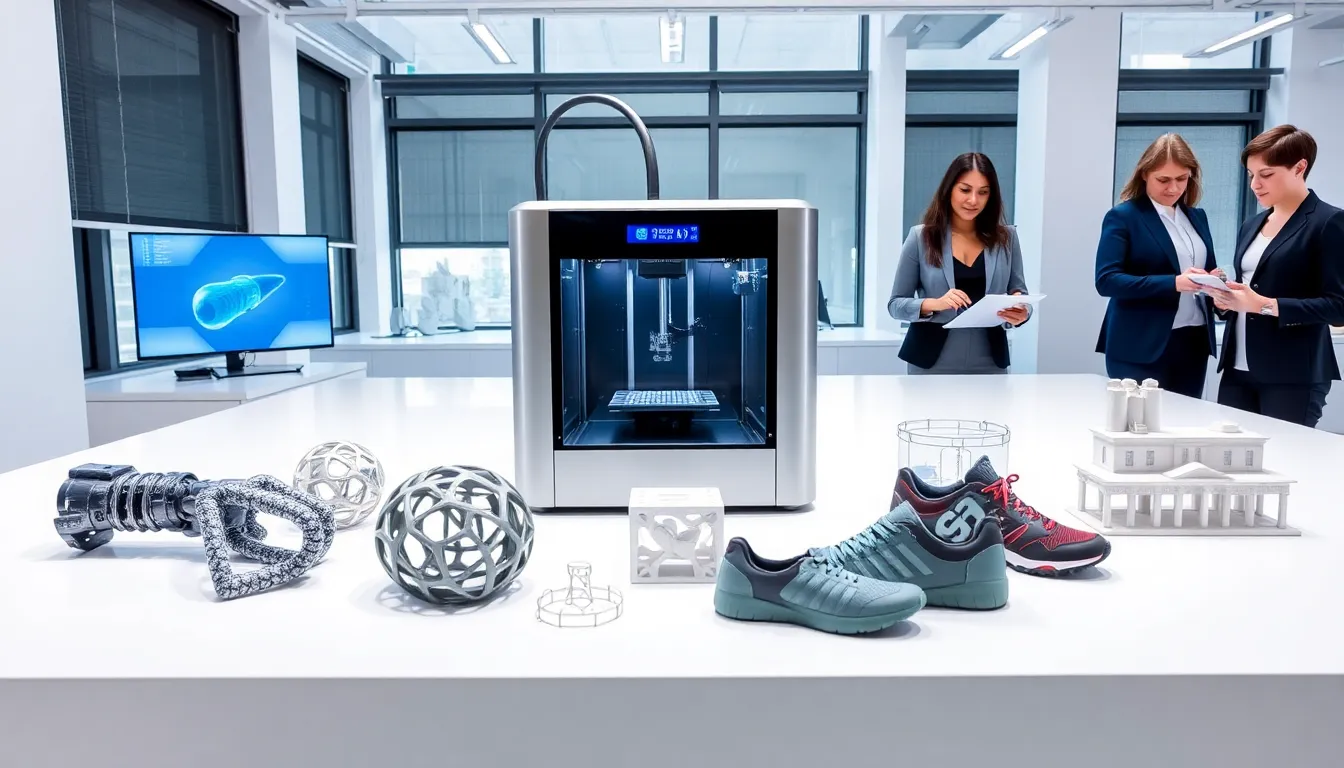
3D printing examples now span nearly every major industry, from hospitals producing custom implants to car manufacturers building lighter, stronger parts. This technology, also called additive manufacturing, creates physical objects layer by layer from digital files. What started as a tool for rapid prototyping has become a production method that saves time, cuts costs, and enables designs that traditional manufacturing simply can’t achieve.
The global 3D printing market reached over $18 billion in 2023 and continues to grow rapidly. Companies large and small use this technology to solve real problems: shorter supply chains, personalized products, and faster innovation cycles. Below, readers will find concrete 3D printing examples from healthcare, aerospace, consumer goods, construction, and education, each showing how additive manufacturing reshapes what’s possible.
Table of Contents
ToggleKey Takeaways
- 3D printing examples span healthcare, aerospace, automotive, construction, and consumer goods, proving the technology’s versatility across industries.
- Healthcare uses 3D printing to create custom prosthetics, surgical models, and dental aligners—reducing costs and improving patient outcomes.
- Aerospace giants like Boeing and GE Aviation use 3D-printed parts to reduce weight, cut assembly complexity, and save fuel over an aircraft’s lifetime.
- Construction-scale 3D printing can reduce home building costs by 30-40% and complete structures in under a week.
- Startups and educators benefit from rapid prototyping, turning digital designs into physical products within hours for faster iteration and learning.
- The global 3D printing market surpassed $18 billion in 2023, signaling continued growth and adoption across sectors.
Healthcare and Medical Applications
Healthcare offers some of the most impactful 3D printing examples today. Surgeons use patient-specific anatomical models printed from CT and MRI scans to plan complex operations. These models let doctors rehearse procedures before entering the operating room, reducing surgery time and improving outcomes.
Custom prosthetics represent another major application. Traditional prosthetic limbs can cost thousands of dollars and take weeks to produce. 3D printing cuts both cost and production time dramatically. Organizations like e-NABLE have provided thousands of free 3D-printed prosthetic hands to children worldwide.
Dental applications have also embraced this technology. Orthodontists produce clear aligners, crowns, and surgical guides using 3D printers. Companies like Align Technology (maker of Invisalign) print millions of custom aligners each year.
Bioprinting pushes boundaries even further. Researchers now print living tissue structures using bio-inks made from human cells. While fully functional 3D-printed organs remain years away, scientists have successfully printed skin grafts, cartilage, and blood vessel structures. These 3D printing examples in healthcare demonstrate how the technology saves lives and reduces medical costs.
Aerospace and Automotive Manufacturing
Aerospace companies pioneered many industrial 3D printing examples. Boeing uses over 70,000 3D-printed parts across its aircraft fleet. GE Aviation prints fuel nozzles for its LEAP jet engines, parts that previously required welding 20 separate components now come out as single pieces.
Weight reduction drives much of this adoption. Every pound saved on an aircraft translates to fuel savings over its operational lifetime. 3D printing enables lattice structures and organic shapes that reduce weight while maintaining strength. These designs would be impossible with traditional machining or casting.
The automotive industry follows similar patterns. BMW prints over 300,000 parts annually, including components for its production vehicles. Ferrari uses 3D printing for prototyping and produces some final parts this way. Electric vehicle makers like Rivian use the technology extensively for rapid iteration during development.
Formula 1 teams rely heavily on 3D printing examples for competitive advantage. Teams can design, print, and test new aerodynamic components within 24 hours. This speed allows dozens of design iterations per race season, something unthinkable with traditional manufacturing timelines.
Spare parts production represents a growing use case. Instead of maintaining warehouses full of replacement components, manufacturers can print parts on demand. This approach reduces inventory costs and ensures parts availability for older equipment.
Consumer Products and Everyday Items
Consumer-facing 3D printing examples have multiplied in recent years. Eyewear companies like Luxexcel print prescription lenses directly, eliminating grinding and polishing steps. Custom-fit glasses frames from companies like Fitz Frames use facial scans to create perfectly sized eyewear.
Athletic footwear showcases creative applications. Adidas produces the 4DFWD running shoe with a 3D-printed midsole designed for optimal energy return. New Balance and Under Armour offer similar products. These lattice-structured midsoles provide cushioning patterns impossible to achieve through injection molding.
Jewelry design has been transformed by 3D printing. Designers create intricate pieces that would require hundreds of hours of hand fabrication. Lost-wax casting combined with 3D-printed molds enables small jewelers to compete with larger manufacturers on complexity and customization.
Home goods offer accessible 3D printing examples for everyday consumers. Companies sell 3D-printed furniture, lighting fixtures, and decorative items. The technology enables mass customization, buyers can modify designs to match their preferences before production.
Food printing has emerged as an unexpected application. Restaurants use 3D printers to create elaborate chocolate sculptures and pasta shapes. NASA has funded research into 3D-printed food for long-duration space missions, where customized nutrition could support astronaut health.
Architecture and Construction
Construction-scale 3D printing examples are reshaping how buildings get made. ICON, a Texas-based company, has printed multiple homes in the United States and Mexico. Their Vulcan printer can produce the walls of a 2,000-square-foot home in under a week.
The technology addresses housing affordability and speed. A 3D-printed home can cost 30-40% less than traditional construction. Labor requirements drop significantly since the printer handles much of the structural work. In regions facing housing shortages, this speed and cost advantage matters.
Architectural models remain a common use case. Firms print detailed scale models of proposed buildings for client presentations and design review. What once required weeks of model-making now takes days. These 3D printing examples help architects communicate designs more effectively.
Dubai has committed to having 25% of its new buildings 3D-printed by 2030. The city already houses the world’s largest 3D-printed building, a two-story structure completed in 2019. China has demonstrated multi-story 3D-printed apartment buildings.
Infrastructure projects are testing the technology too. Bridges, bus shelters, and park benches have been 3D-printed in various cities. The Netherlands installed a 3D-printed steel bridge in Amsterdam, demonstrating the technology’s structural capabilities.
Education and Prototyping
Educational institutions provide excellent 3D printing examples of the technology’s learning potential. Schools from elementary through university levels use printers to teach design thinking, engineering principles, and manufacturing concepts.
Students can turn digital designs into physical objects within hours. This rapid feedback loop accelerates learning. A student can design a part, print it, test it, and iterate, all within a single class session. Engineering programs use 3D printing to help students understand stress analysis, material properties, and assembly design.
Prototyping remains the original and still most common use of 3D printing. Product designers create physical mockups before committing to expensive tooling. A new consumer product might go through dozens of printed prototypes before reaching production.
Startups particularly benefit from these 3D printing examples. Small teams can validate designs without investing in injection molds or machining equipment. This accessibility has lowered barriers to product development and enabled more entrepreneurs to bring ideas to market.
Makerspaces and fab labs have spread this capability to communities. Public libraries, community centers, and coworking spaces now offer 3D printing access. These resources democratize manufacturing technology that once required significant capital investment.